

Last Updated on May 20, 2026 by Anne Brock
Savings through solar is taking off at a central church office in Knoxville, with the next step being energy savings for the smallest churches the organization supports. Bishop Brian Cole has cut the ribbon to celebrate the installation of solar photovoltaics (PV) with a battery energy storage system (BESS) at the Diocesan House for the Episcopal Diocese of East Tennessee. He was joined May 19 by members of the denomination’s Carbon Neutral Task Force, Missioner for Communications and Evangelism Brother Andrew Morehead, a representative from solar contractor Solar Alliance, and others for the milestone event.
“We sought to lead by example…I’m excited to say the system is now fully alive and functioning well.” said Bishop Cole.
Renewable energy is now running most day-to-day operations at the Episcopal Diocesan House in Knoxville, with a state-of-the-art battery energy storage system providing backup for critical loads during a grid power outage. On-site clean energy production can help the Diocesan House, though still grid-tied, operate with a significantly lower monthly utility bill. This savings is key to supporting the next step of the denomination’s project: helping the area’s smallest congregations accomplish savings through energy efficiencies and upgrades.
Volunteer Courtney Shea leads the Carbon Neutral Task Force, saying, “I am very excited about the solar installation at the Diocesan House as an example of how to drastically reduce greenhouse gas emissions from buildings. I am especially looking forward to the establishment of a Carbon Neutral fund for small churches in our diocese with the utility savings. The Carbon Neutral Task Force has been compiling information on best practices. Coupling information and support with funding will help smaller churches take on improvements to lighting and weatherization, which improve energy efficiency in our buildings, resulting in better air quality and lower energy costs. WooHoo!”
The solar + storage project brings the Episcopal Church in East Tennessee closer than ever to their goal of carbon neutrality by 2030. The PV system offsets an estimated 46.7 metric tons of carbon annually. This follows several steps already taken, from LED lighting and attic insulation and more, to enhance conservation at the Diocesan House. The denomination is also assessing carbon footprints for every Episcopal church in the area.
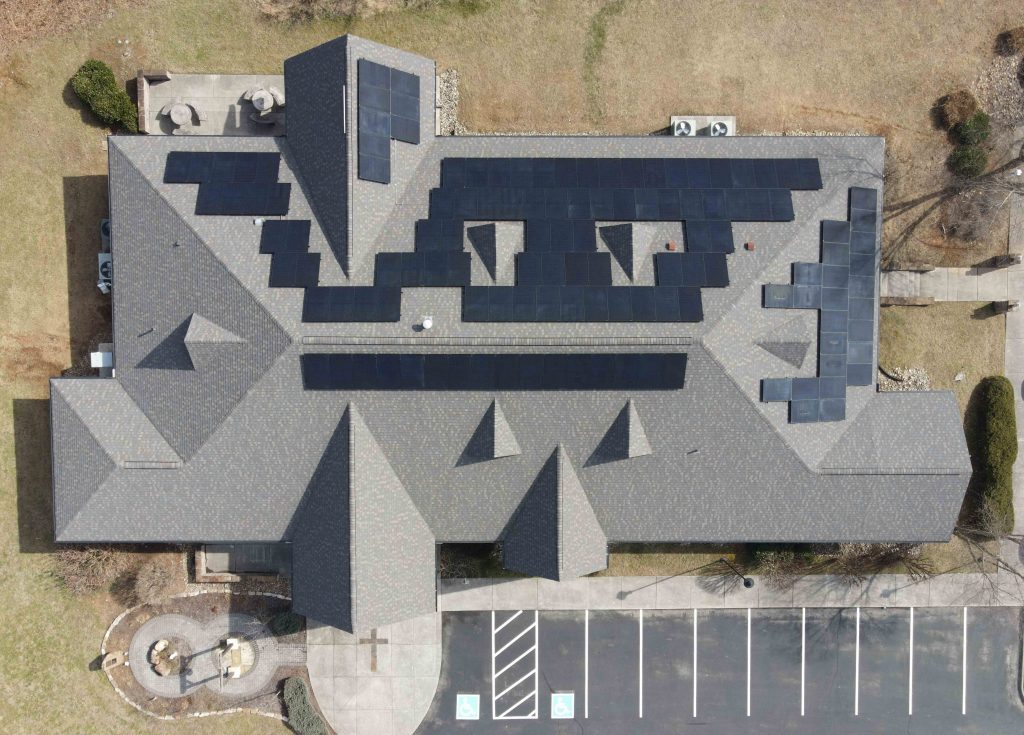
Here is a look at the new energy system by the numbers:
- 46.76 kilowatts (KW) solar PV rooftop system
- 60 kilowatt-hour (kWh) battery energy storage system (BESS)
- Produce approximately 58,400 kilowatt-hour (kWh) of clean electricity each year
- Offset an estimated 46.7 metric tons of carbon dioxide equivalent annually
This is equivalent to preventing annual emissions from:
- 118,808 miles driven by gas vehicle
- 5,250 gallons of gasoline consumed
- 51,825 pounds of coal burned
- 3,172,110 smartphones charged
During the ribbon cutting ceremony for the new system, Bishop Cole reminded the audience that environmental stewardshp falls under the larger umbrella of faith. “While this Earth is our home, the Psalmist reminds us that it is first and ultimately the Lord’s possession, not our own. Since the Days of the Garden of Eden, our first call has been to be stewards and keepers of this Earth. As we continue to see and experience the effects of climate change here in East Tennessee and across the globe, it has become all the more imperative for us to invest in local, grassroots initiatives to address climate change.” You can hear his entire remarks at this link.
For more information on how this nonprofit organization planned and implemented its solar + storage system, contact Brother Andrew Aelred Morehead, OC at amorehead@dioet.org or 865-966-2110.
To hear how other area churches in Tennessee have included solar in their stewardship mission, see here and here.
Contact Solar Alliance here to explore how solar or solar + storage could benefit your church or other nonprofit.